

Collecting Cars: Porsche 911 GT3 RS (996)
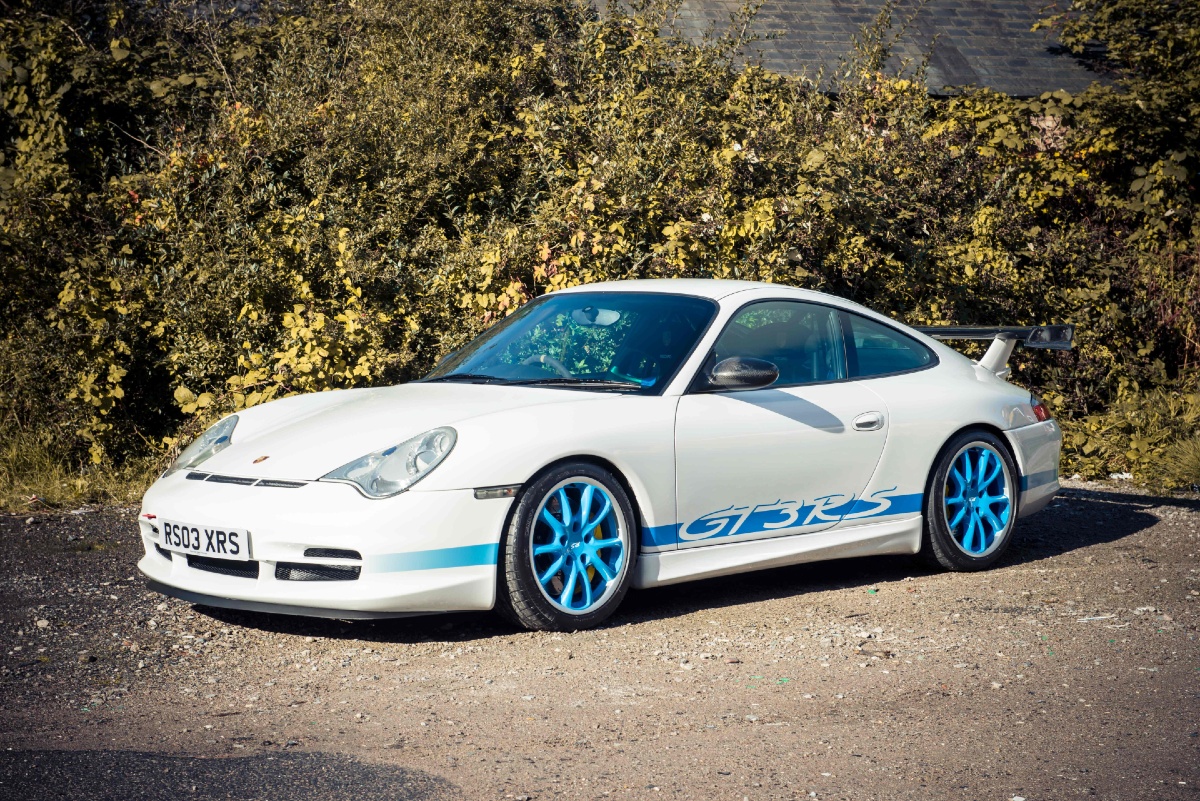
Picture the scene. You have Anglesey race track and the island’s surrounding roads at your disposal for three days, and a BMW M3 CSL, Ferrari 360 Challenge Stradale and Porsche 911 GT3 RS waiting to duke it out on road and track.
Undoubtedly, 2003 was a good year for those who like to get their kicks behind the wheel, and my abiding memory of road– and track–testing this near–perfect threesome was of how different each of these thrilling machines was. The M3 CSL was hilariously driftable, the 360 CS wonderfully theatrical and the 911 GT3 RS was the one that got the job done when it came to putting in some fast laps.
Coveted when new, all three are collectible cars today. But it’s the 911 GT3 RS that is by far the rarest: reports vary, but according to the manufacturers BMW built 1383 CSLs and Ferrari managed 1288 Challenge Stradales, whereas Porsche only produced 682 Rennsport versions of the GT3 (we’ll come to the reason why, shortly). Yet today you could buy a good example of a GT3 RS for half the price of a similarly well-loved Challenge Stradale, while the latest 992 GT3 RS is more common than a standard 911 Carrera. It’s food for thought for car enthusiasts who are weighing up adding a first generation GT3 RS to their collection. Let’s take a deeper dive into what makes it tick.
History and technical background of the 996 Porsche 911 GT3 RS
.jpg)
When Porsche revealed the 911 GT3 RS in 2003, to enable it to homologate the RSR spin-off for motor racing, it arrived as a lightly disguised racing tool: white paint (no other colour was available), contrasting blue or red decals and wheels, a fixed rear wing and an air of seriousness that we’d not seen from Porsche’s competitors.
It set the template from which subsequent Rennsport 911s would follow. However, unlike later GT3 RS models, which would lean increasingly into brand mythology, the original RS existed for a single, practical reason: to go racing.
In concept and execution, it captured a moment in time when homologation genuinely mattered, and if that meant including a half roll-cage at the expense of deleting side-impact airbags – which in turn meant it couldn’t be sold in the all-important US market – then so be it, and hence its rarity.
Testing it when new, the GT3 RS left a lasting impression. It did not flatter the driver or attempt to dilute the experience. Instead, it demanded all of your focus and a considered technique to get the most out of its immense traction and impressive (for the time) downforce. In return, you enjoyed getting to grips with its formidable abilities, and would always find a little bit more within its depths each time you drove it.
We now know it is one of the most raw and visceral 911s Porsche has produced. Based on the second-generation 996 GT3, the RS was stripped back with purpose. Weight saving became the guiding principle. A carbon-fibre bonnet, polycarbonate rear screen, thinner glass and reduced sound insulation all contributed to a meaningful reduction in mass. The result was a kerb weight of around 1,360kg, giving the RS an edge in agility and response over the standard GT3 – which was 50kg heavier.
As significant were the suspension changes. Much of this was down to the need to homologate RSR racing parts: compared with the standard GT3, there were new hollow-cast uprights and strengthened wheel hubs to give better camber control, a different anti-roll bar setup, and shorter, stiffer springs tuned for track use and, to top it off, there were adjustable control arms.
Power came from a 3.6-litre naturally-aspirated flat-six, producing 375hp, and a ram-air effect from the front intake was said to help gain it 10 of those horses at high speed. With a hint of superiority, Porsche people will refer to this as a Mezger engine. Named after Hans Mezger, who oversaw Porsche’s race car design and development, its unique technical configuration became the stuff of legend. (There’s a good techie profile of it here.)
While unchanged on paper over the GT3, the engine felt sharper in the RS thanks to a different flywheel, reduced weight and revised gearing. Drive was sent exclusively to the rear wheels via a six-speed manual gearbox and a mechanical limited-slip differential, and with 375bhp at 7400rpm and 284lb ft from 5000rpm the RS could crack 60mph in 4.2 seconds and go on to 190mph.
Driving the 996 GT3 RS
.jpg)
Even today, the GT3 RS feels refreshingly uncompromised. There are no modes to select, no systems to manage, no attempt to make the experience more accessible than it needs to be. In other words, the driver is in control and very much on their own.
The cabin is sparse, the controls weighty and the feedback immediate. Contemporary road tests captured the essence of the car. Evo magazine described it as “the most vivid expression yet of Porsche’s racing DNA”, noting the sense of connection and the way the car responded to precision rather than bravado. Autocar highlighted its breadth of ability, observing that while the RS was ferociously capable on track, it remained usable on the road for those prepared to accept that comfort was never the priority. Car magazine, meanwhile, focused on the purity of the experience, praising the steering feel, braking performance and unfiltered communication that defined the RS.
The steering remains a standout, even by modern standards. Free of slack, it delivers constant information, encouraging the driver to lean into the car’s natural balance and immense traction. The Mezger engine has a mechanical honesty about it but ultimately thrives on revs, with a howling top-end you’ll never tire of exploring. On track, the RS feels closely related to its Cup car cousin, yet on the right road it has enough finesse to not get thrown around by our crumbling roads.
As a former owner of not one but two examples of the GT3 RS, Racing Green’s Oliver Hagger stresses how important geometry setup is to getting the best from the cars. “These cars are sensitive to setup,” says Hagger, “and alignment changes how they feel. In its best form, the RS is sublime; set incorrectly, particularly with aggressive track settings, it can feel brittle and tiring on the road. Specialist attention from respected names such as Paragon or Center Gravity is key to unlocking the car’s full potential.”
Buyer beware: what to look out for
.jpg)
There are some car-buying basics all buyers should be on the look out with the original GT3 RS, and some points specific to the model. First and foremost, find out as much as you can about the car’s history and nail down whether or not it has ever been crashed. Given how many have been tracked, accident damage is not uncommon – and if it has, this should be clearly documented in the car’s history file, with evidence of repairs by a reputable specialist.
For much the same reason, a mechanical inspection is recommended. The good news is that the car only came with a manual gearbox, so there’s no fear of troublesome ECUs affecting the PDK system. The bad news is if a past driver has missed a gear and badly over-revved the engine there could be internal damage. A Porsche specialist, like Paragon, can easily check this through the car’s ECU.
During that mechanical inspection, it’s also important to have a thorough appraisal of the underside. Its body was galvanised, but given these cars are in their twenties corrosion needs to be looked out for, whether on the floorpan, arches, in the engine bay or around areas like the windscreen and rear window. A quirk of this generation RS is for the paint on the carbon-fibre bonnet to bubble. You’ll also want to know about remaining life of the brake discs and pads, condition of the brake lines, tyre tread depth and age of manufacture, and whether or not the suspension bushes (some parts are rose-jointed) are past their best.
Market overview and values: 911 GT3 RS (996)
.jpg)
For a long time, the 996 GT3 RS lived in the shadows. As tastes shifted and newer GT3 RS models arrived with more power, presence and technology, early cars fell out of demand and values softened – significantly.
Some examples were being sold for as little as £50,000 in the early 2010s. But over time the market has swung back. Survivors in original, well-maintained condition are increasingly prized, particularly given the car’s low production numbers and its status as the first GT3 RS. Growing interest from the United States, where the model was never sold new, has added further momentum. Look at auction sales results over the past five years and the curve of average prices is very much climbing.
In the UK, according to The Classic Valuer, values now typically sit between £120,000 and £170,000, with a median price of £156,197 since 2020, and an auction record of £298,660, set at the 2023 Amelia Island Auctions. A cursory glance at PistonHeads reinforces this upward trend, where the classifieds show a range of values starting from £115,000, depending on mileage, condition and history. You'd need to pay twice as much for a nice 360 Challenge Stradale.
More than two decades on, the 996 GT3 RS stands as one of the purest performance cars Porsche has created. Not a tribute, not a nostalgia act, but a genuine homologation special whose significance as the start of the modern-era RS line continues to grow, making it increasingly appealing to collectors as much as the enthusiasts it was originally aimed at.
If you would like to know more about Racing Green’s acquisition services, or arrange for your car to be placed in our care, please speak with a member of the team, on 03330 909722, or email us at enquiries@racinggreencarstorage.co.uk

View Gallery

Subscribe
Sign up to our newsletter to get all the latest news, events and more from the Racing Green team.
By filling out this form, you agree to the terms laid out in our privacy policy
Redefining collector car storage

By filling out this form, you agree to the terms laid out in our privacy policy


Let's start a conversation...
Please note: Your comments will need to be approved before they are shared with our community. Have fun. Don't be rude or mean. Feel free to criticise ideas, not people. Bad behaviour will not be tolerated.
Lorem ipsum dolor sit amet, consectetur adipiscing elit. Suspendisse varius enim in eros elementum tristique. Duis cursus, mi quis viverra ornare, eros dolor interdum nulla, ut commodo diam libero vitae erat. Aenean faucibus nibh et justo cursus id rutrum lorem imperdiet. Nunc ut sem vitae risus tristique posuere. uis cursus, mi quis viverra ornare, eros dolor interdum nulla, ut commodo diam libero vitae erat. Aenean faucibus nibh et justo cursus id rutrum lorem imperdiet. Nunc ut sem vitae risus tristique posuere.
Delete